
Chlorinated latex for the catsuit and clothing industry
Chlorinate latex yourself or get it done.
Chlorinated latex, many of you know what chlorinated rubber is, how it feels, wears or smells. However, many newcomers have no experience at all and can’t imagine what it is about. But there are also many people, who are just as enthusiastic about latex as we are, who chlorinate their latex clothes themselves with, more or less, good results, thereby mostly in relation with the latex clothing itself. Therefore, based on various instructions online, it is frequently encouraged to treat your existing latex yourself. However, you have to be cautious, not only in respect of the latex clothes, but also about the arising perils and risks.
Chlorinated latex for the catsuit and fashion industry without surcharge
Chlorinated latex can be worn without any fitting aids, such as silicone oil or talcum, chlorinated latex doesn’t stick together anymore and it’s not as susceptible towards ozone, UV light, as well as liquids, such as sweat. Furthermore, chlorinated latex minimises the widely-spread latex allergy, with which even allergy sufferers can partly wear latex clothes. There are many advantages, however there are also disadvantages that arise with treated latex. Especially repairs on thin material thickness, such as 0.18mm, 0.25mm up to 0.5mm are nearly impossible. The repaired spots will repeatedly open themselves, reinforcements, which have been inserted, will become loose and no stability can be achieved in the parts that stretch the most. You can frequently read and hear about that chlorinated rubber won’t smell nice anymore and the scent will fade. We can now reassure you that there are very good care products, which can bring back the latex-typical scent and sweet fragrance. Furthermore, during the chlorination, it is possible to flush so well that the scent, or the inherent smell of the latex, can be preserved.
Allergy sufferers can wear chlorinated latex clothing
Allergies, in general, have increased more and more and many of us suffer from hay fever and are allergic to dust mites and some are allergic to latex. Latex allergy is also on the rise and an increasing number of people are affected by it. It is mainly concerned with a contact allergy when the skin comes in direct contact with latex. The allergic reaction itself, the anaphylaxis, mainly shows itself through reddened skin, itching in the crook of the arms and legs and, in worst cases, can lead to anaphylactic states of shock, which can lead to death. Nausea up to being sick, a state of anxiety and restlessness, heart and circulation problems, breathlessness and severe drowsiness can be allocated to a latex allergy. Natural latex, natural caouchouc, can be found in many products that are used daily, such as dummies. Therefore, it has to be made sure that also after the contact, up to 72 hours, there are no signs of allergic reactions on the skin as well as the above mentioned complications. An allergy to latex can also be allocated to the delayed-type allergy, accordingly the non-immediate emerging allergic reaction, but the delayed one. But also in the safe home you can suffer reactions in in form of plants and cross-hypersensibility reactions, such as the poinsettia as well as the Benjamin’s fig. Cross-hypersensibility, especially when it comes to extreme allergic reactions to a specific material, here latex, natural caouchouc. Therefore, latex allergy sufferers mostly react to certain subtropical fruit, such as bananas, walnuts and kiwis. Especially in occupational groups in the medical sector is a high number of people who suffer from a latex allergy, an estimated 18%. Caution has to be provided when asthma or neurodermatitis are present symptoms. This is even difficult with chlorinated latex, as the danger of a heavy allergy to the rubber is very high, respectively the possibility of an induced state of shock.
Summarising, it can be said that allergy sufferers can wear latex but they should solely reach out for chlorinated latex clothing slowly herantasten. Latex allergy sufferers should pay attention to everyday items, such as:
- elastic bands
- elastic bands in bras
- latex in stockings
- table cloths, table pads
- dispersion paint
- matrasses in general, latex matrasses anyway
- erasers
- household gloves
- sealing rubber
- garden hose
- certain keyboards of telephones
- computer equipment, such as the mouse
- pet toys
- lettuce, figs, chicory, asparagus
- body care products with almond and avocado oils
- condoms
- chewing gums
- balloons
Chlorinated latex available here without surcharge
In the Latexcrazy latex shop not only allergy sufferers but all our customers receive chlorinated latex without having to pay a surcharge for it. Especially for people who are allergic to latex this is an advantage, however, before placing your order you should let us know about your allergy as we will soak your new latex clothing, such as the latex catsuit, in water for 24 hours and rinse it several times before starting the chlorination process. By doing so, the allergy-provoking proteins as well as excess paint and talcum will be removed completely.
The chlorination, chlorinated latex, is a chemical process, which more specifically arises from this treatment, through which the so called chlorinated latex emerges. Our main interest usually isn't the chemical reaction behind it but rather the result in interaction with the latex clothes, such as latex catsuits and latex lingerie, are of significant importance. In a liquid element, in this case water, chlorine is being dissolved and by adding certain chemical substances, such as muriatic acid, the gas is released, the dangerous chlorine gas. During the chemical process, the release of this chlorine gas, latex clothes, for example the latex catsuit is dipped into the liquid for several seconds or minutes and gets moved and turned. During the chemical reaction with the composite the surface is being changed in a way that she turns glossy. This means that, symbolically written, the overhanging connections, such as little arms which are trying to grab one another, which causes the latex is stick, are cut off and chlorinated latex is formed. The protein molecules, which are dangerous for allergy sufferers, will be sealed and allow limited wearing of latex clothing, such as latex catsuits. Furthermore, latex cloves in the medical and hygienic sector have been treated this way for years. Especially in the medical field with millions of people in the care sector, this kind of treatment is now indispensable. On the one hand, it eliminates the risk of an allergic reaction almost completely and on the other hand, it essentially increases the level of comfort. The actual advantage, especially for lovers of glossy latex clothes from the Latexcrazy latex shop, is that you can wear it without donning aid, such as talcum or silicone oil. However, you can still obtain the glossy look on the outside of your new latex clothes without any problem by using a small amount of silicone oil.
You can easily wear chlorinated latex without any donning aid
In our latex shop you receive chlorinated latex without surcharge as this service is already inclusive, as well as non-chlorinated latex, you decide. You therefore don’t have to chlorinate your latex clothes yourself or use the expensive service of a third-party supplier. Decide for chlorinated latex and experience a completely new comfort and feeling of wearing. We chlorinate latex for you by the producer of Radical Rubber, 4D Supatex, Latexa as well as effect and structured latex by the latex manufacture in all current colours and material thickness. We point out that, especially with a bright colour shade, such as white, yellow and pink, the colours may darken and small stains can appear. If you want to chlorinate your latex clothes without doing it yourself and you don’t want to spend a fortune, then ask us and we are happy to help you.
Where does latex come from? – From the juice to the chlorinated latex catsuit
Latex is basically nothing else than natural caouchouc, a small amount of sulphur and water. Latex vulcanises by itself as it holds a small percentage of sulphur. Latex is traded worldwide in liquid form and is stored in barrels. As liquid latex would vulcanise within a short period of time, a part of ammonia is added, whereby we differentiate between low-ammonia and high-ammonia in liquid form. Through ammonia, the pH-level is kept alkaline so that the process of the vulcanisation only starts when it gets in contact with oxygen due to the evaporation of the ammonia. Besides, heat promotes the vulcanisation process and is employed in the industrial production on belts. The raw, so called pre-vulcanised latex, is used as a bonding agent for the production of glued latex clothes, such as the latex catsuit, paper glue and as dyed liquid latex, for example for body painting and felt shoes. Latex is made from the milk-like sap of the rubber tree, also called caouchouc tree, Hevea brasiliensis. Furthermore, the native South-Americans called this tree ‘Ca-Hu-Chu’, which can be translated as ‘crying tree’ and describes the leaking milky sap, the latex, natural caochouc in its pure form. This species of plant is also called para-rubber tree and derives from South America. The rubber tree belongs to the family of the milk-bushes and has an immense economical as well as cultural meaning. Especially the economical meaning is worldwide gigantic, as from the milk-like sap, natural latex, or simply latex, can be extracted and serves as the only renewable source of raw materials.
Meanwhile, the largest part is won from synthetic latex, or caouchouc, through the so-called petro-chemical production.
The following Wikipedia graphic gives you a rough overview regarding the origin and the output.
Sources: Wikipedia, source, graphic, visit Wikipedia for more informations
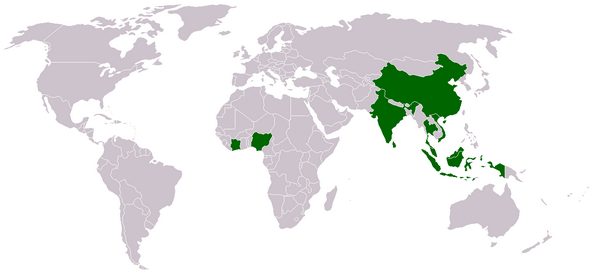
| place | origin | production load (in thousand tons) |
|---|---|---|
| 1 | Thailand | 3030 |
| 2 | Indonesia | 1792 |
| 3 | Malaysia | 1000 |
| 4 | India | 694 |
| 5 | China | 550 |
| 6 | Vietnam | 391 |
| 7 | Ivory Coast | 123 |
| 8 | Nigeria | 112 |
| 9 | Liberia | 108 |
| 10 | Brasil | 96 |
| 11 | Sri Lanka | 92 |
| 12 | Philippines | 88 |
| 13 | Guatemala | 50 |
| 14 | Kambodscha | 46 |
| 15 | Kamerun | 46 |
| 16 | Myanmar | 36 |
| 17 | Mexico | 23 |